Wash Impression Best Practice
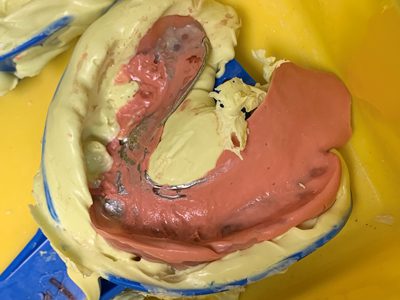
Ensuring Precision for Relines, Rebases, and Tooth Additions
Achieving a successful outcome for removable repairs and modifications depends entirely on the accuracy of the final impression. At Modern Dental Creations, we advocate for specific "wash" and "pickup" techniques to ensure your patients receive a perfectly fitting restoration with minimal chairside adjustments.
Cast & Acrylic Partials
For relines or adding teeth to metal or acrylic frameworks, a pickup impression is the clinical standard.
- Seating: Verify the partial is completely seated in the arch before injecting PVS wash material.
- Flow Control: Syringe material should only occupy the specific areas requiring the reline or addition.
- Transition: The wash material should "feather" smoothly into the original base. Thick "ledges" or rolls of material suggest the partial was not fully seated or the material was overloaded.
- Additions: If adding a new tooth, your pickup impression must capture the entire buccal flange area of the new tooth site within the tray.
Flexible Partials (Valplast/tcs)
Modifying flexible restorations requires specific anatomical anchors to ensure longevity.
- Anchor Teeth: A tooth addition is only predictable if it can be bonded to an existing resin tooth on the appliance. For example, adding #8 requires #7 or #9 to be present as an anchor point.
- Technique: Capture the partial in a pickup impression, ensuring the edentulous site and the buccal flange are clearly defined.
- Clasp Relocation: We can often fabricate new flexible clasps for adjacent teeth if the original abutment tooth is being extracted and added to the partial.
Complete Dentures
When performing a wash impression for a full denture or a try-in:
- Pressure Relief: Create a small vent hole in the palatal region to allow excess PVS to escape, preventing a "rebound" effect.
- Occlusal Verification: Have the patient close into centric relation while the material sets. If the Vertical Dimension (VD) increases, the wash is too thick; the material must be stripped and retaken to avoid an open bite.
Troubleshooting: Common Impression Errors
To avoid lab delays and remakes, please review these common clinical pitfalls:
- Missing Tray Support: Taking a wash inside a partial without a pickup tray fails to capture the surrounding anatomy and buccal flanges, making model fabrication impossible.
- Improper Seating: If syringe material covers the entire metal major connector or areas that do not require a reline, the partial was likely displaced during the impression.
- The "Roll" Effect: Thick, rounded borders of impression material (rather than a feathered edge) indicate that the partial was floating and not in direct contact with the tissue.
- Incomplete Palatal Capture: A reline that fails to capture the full vault or displays thick margins in the palate will result in a poor suction seal.
Partner with Our Technical Team
Precision at the chairside leads to excellence in the laboratory. If you have questions regarding a complex tooth addition or a difficult reline, our technicians are available for consultation.